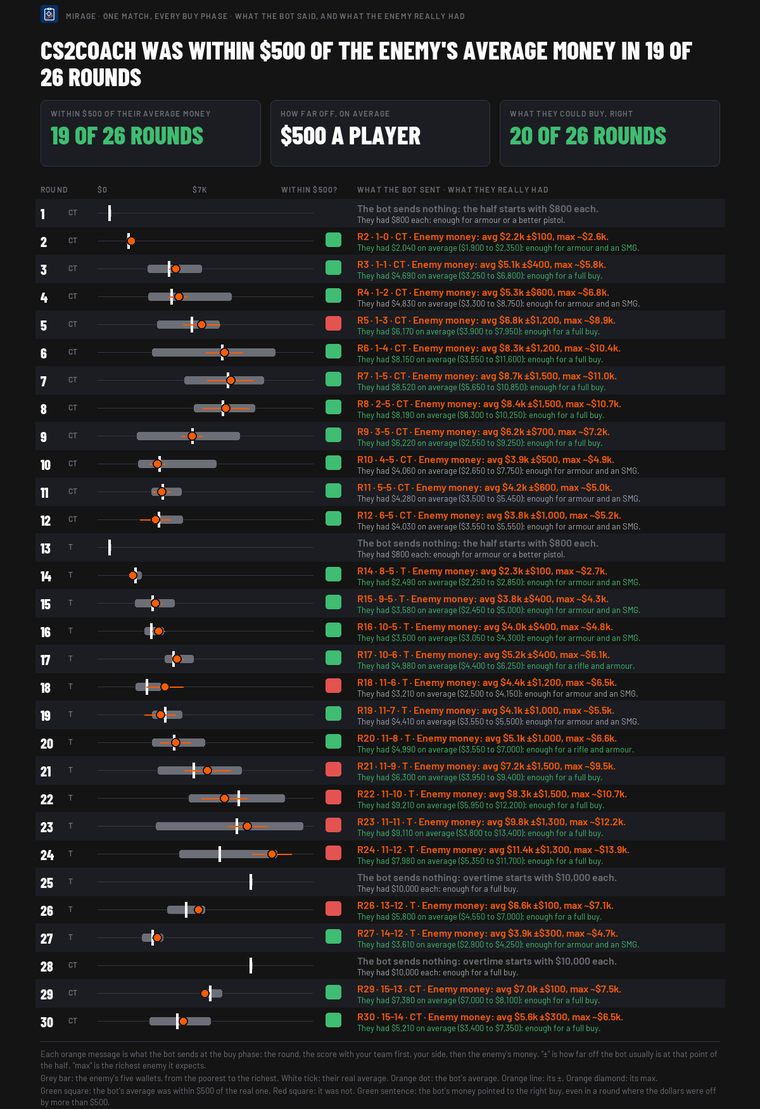

From round six of each half, it correctly predicts the enemy's buy, in five steps from broke to a full buy, 63% of the time.† A careful IGL counting by hand gets it right 55% of the time.*
The chart and how it was tested
Correct predictions out of every 100 rounds. The dashed line is 46%. That is what you get by always guessing the most common buy.
Why counting by hand stops near 55%
Counting by hand, with only what the game shows, tops out around 55%. No hand rules tested did better. CS2coach learned from thousands of professional rounds how teams really spend, and gets it right 63% of the time on your own.
Getting past 55% takes more than counting. It takes knowing how thousands of professional rounds were really bought. A team of analysts could work toward that between rounds. CS2coach does it in 3.6 seconds.
In force-buy rounds, it spots the force 54% of the time. A careful IGL counting by hand spots about 40%.
* Why hand rules stop near 55%: fixed rules of thumb can't capture how teams really spend at every money level. A computer model given only what a player can see, including the scoreboard, gets it right 71% of the time. It learned from thousands of professional rounds when teams force, when they half-buy and when someone drops a gun. (Tested on 26,800 buy phases from round six of professional matches.)
What a careful IGL does in freeze time
To predict the enemy's buy by hand, a careful IGL has to do all of this, every round, before the freeze time ends:
- Track the loss bonus. Count each enemy's losses in a row and the money it pays.
- Count their income. Note who got kills, with which gun, and whether they planted.
- Count how many of them survived. Survivors keep their gun and only rebuy armour and grenades ($1,700 on T, $2,000 on CT).
- Know when they must force. That means after a lost pistol round, in the last round of each half, and at match point.
- Know who can buy. A player who died buys a rifle only when they have the rifle price ($3,700 on T, $4,000 on CT); otherwise they save.
Done without a single mistake, every round, these rules get the enemy's buy right 55% of the time. That is the best any hand method reached in the test. CS2coach does it for you in 3.6 seconds and gets it right 63% of the time.